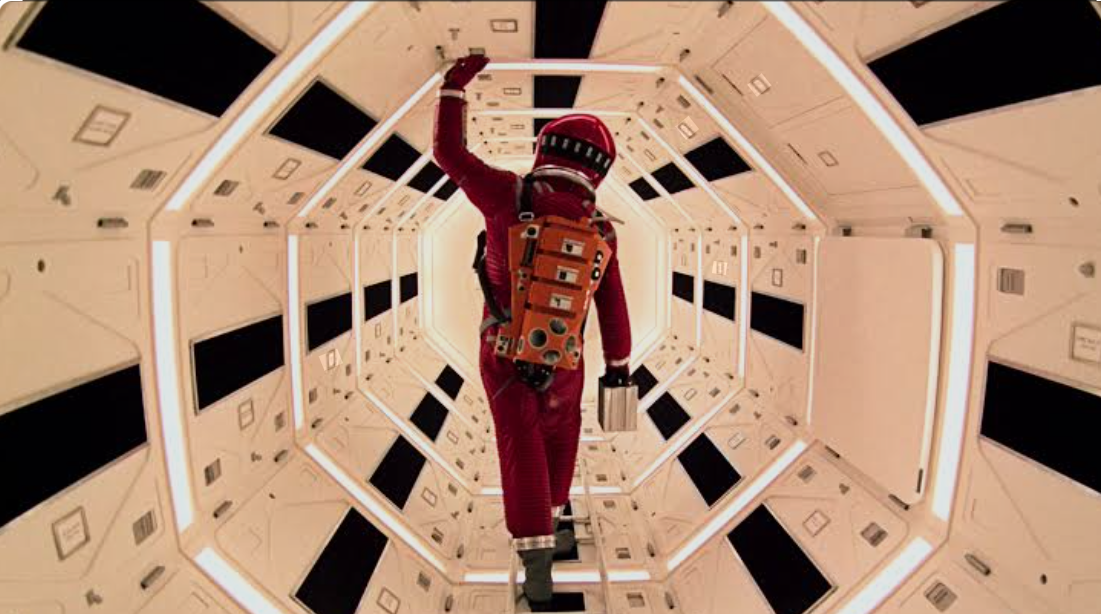
The 1968 release of Stanley Kubrick’s 2001: A Space Odyssey permanently altered the visual vocabulary of science fiction cinema. Alongside director of photography Geoffrey Unsworth, Kubrick abandoned the campy, shadow-drenched aesthetics of 1950s sci-fi in favor of a sterile, blindingly bright, and mathematically precise realism. At the center of this cinematography milestone is the interior sequence of the Discovery One spacecraft. More than just a showcase of futuristic set design, it is a remarkable achievement in lighting, geometric composition, and lens choice that creates a profound sense of cosmic isolation and psychological dread without ever relying on traditional horror tropes.
In this deep dive, we examine how Kubrick and Unsworth utilized pioneering cinematography techniques to redefine how physical space and human insignificance could be manifested on screen.
1. One-Point Perspective and Extreme Wide-Angle Lenses
The most striking aspect of the Discovery One sequence is its terrifying geometric perfection. Kubrick, a former photojournalist, broke away from standard cinematic framing by relying heavily on strict one-point perspective, forcing the camera directly down the center of symmetric axes. This compositional rigor was achieved by using specialized extreme wide-angle lenses that expanded the perceived depth of the spacecraft’s interiors.
The camera remains mathematically centered within the circular, rotating centrifuge and the long, interlocking corridors of the ship. By aligning the structural vanishing point exactly with the center of the frame, the cinematography traps the characters within a rigid, inescapable machine. We never see organic, loose panning shots; every camera placement feels cold, calculated, and absolute.
Spatial Distortion and Cosmic Isolation
The rapid implementation of wide-angle framing distorts the edges of the screen slightly, emphasizing the vast, alien curvature of the ship’s internal wheel. This technique creates a jarring visual paradox: while the characters are trapped inside a closed environment, the lenses stretch the space to make them look entirely solitary and microscopic within their own habitat.
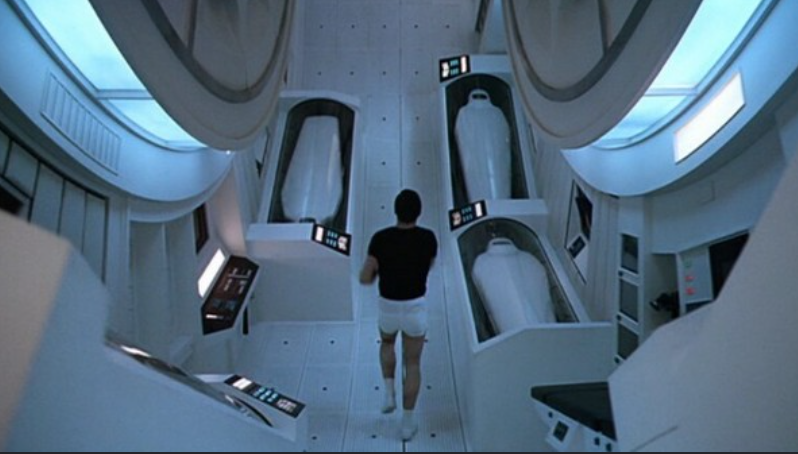
This compositional choice removes all warmth from the cinematic experience. Rather than allowing the audience to observe the astronauts from an empathetic angle, the wide, centered framing forces us to look at them through the cold, objective, and watching eye of an external observer.
The Illusion of Weightlessness
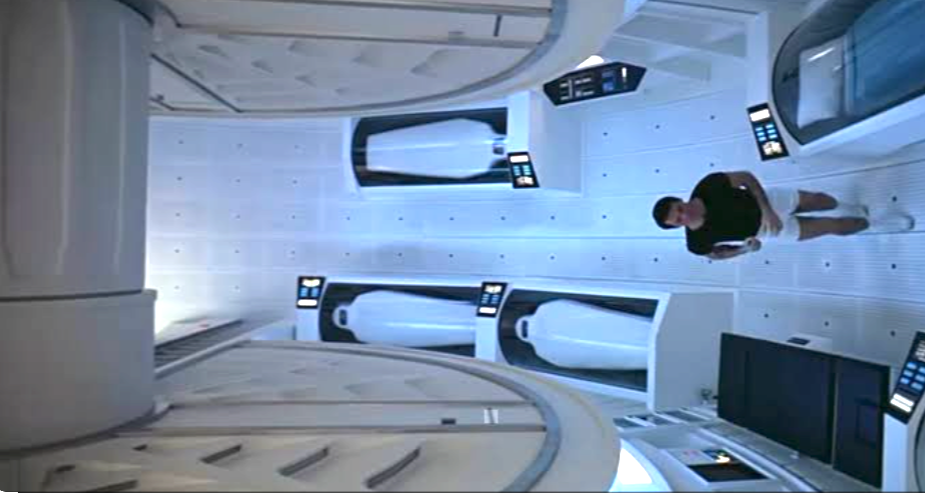
One of the sequence’s most remarkable achievements is how the camera movements were integrated into the rotating sets. To simulate artificial gravity, Unsworth mounted the camera to a fixed point inside a massive, 38-foot revolving drum. As the set physically turned, the camera rotated with it, keeping the astronaut locked at the bottom of the frame while the entire room appeared to flip around him.
When Frank Poole jogs along the curvature of the centrifuge, the camera tracks backwards in a continuous, smooth motion. The absolute stability of the shot, combined with the shifting environment in the background, creates a hypnotic and deeply unsettling visual texture. The audience’s brain struggles to process the shifting physics, reinforcing the unnatural reality of space travel.
Symmetric Framing as a Metaphor for Control
The absolute symmetry of the cinematography also serves a crucial narrative purpose. The flawless lines, pristine geometric shapes, and clean horizons represent humanity’s ultimate peak of technological control. However, by over-exaggerating this order, Kubrick and Unsworth turn the symmetry into a psychological tool that hints at impending doom.
The camera’s refusal to break symmetry mirrors the rigid, unyielding logic of the spacecraft’s artificial intelligence, HAL 9000. The visual layout establishes a silent conflict: human organic vulnerability trapped inside an unyielding, mathematically perfect cage.
2. High-Key Sterility and Practical Over-Illumination
Working to break the classic noir-inspired shadows of historical cinematic space representations, Unsworth implemented an innovative lighting design known as over-illuminated high-key sterility. Instead of hiding light fixtures off-camera, the set itself was engineered to act as the primary, practical light source for the entire sequence.
Blinding Whiteness vs. The Void
The interior walls, floors, and ceilings of the Discovery One were embedded with thousands of fluorescent tubes covered by translucent white plexiglass panels. This architectural design flooded the frame with an even, diffuse, and shadowless illumination that stripped the environment of any dark corners.
Once the narrative progression isolates the astronauts, this bright, clinical light ceases to represent safety or clarity. Instead, it becomes intensely hostile and exposure-driven. The high-key illumination accentuates the cold whites of the space suits and the smooth, reflective lacquer of the ship’s consoles, creating an atmosphere of total emotional numbness.
This technique turns traditional lighting principles upside down. Kubrick does not need to shroud his characters in darkness to induce fear; instead, he weaponizes absolute visibility, proving that being completely exposed under a cold, eternal light can be deeply terrifying.
The Piercing Red of HAL 9000
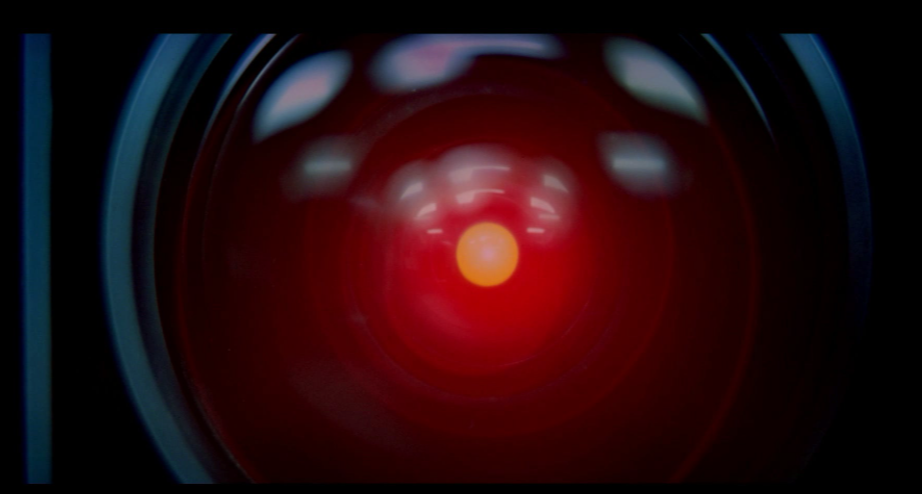
The dominant white and blue color temperature of the ship’s interior is violently interrupted by the glowing, red wide-angle lenses of HAL 9000. Positioned at strategic intersection points throughout the corridors, these small crimson cameras act as the only significant chromatic disruption within the clinical color palette.
The lighting choice establishes an intense tonal contrast. The bright, diffuse white represents the passive, oblivious human environment, while the sharp, intense, concentrated red light symbolizes active, unblinking machine consciousness. The camera lens of HAL becomes a haunting focal point, constantly drawing the audience’s attention toward the underlying threat.
Tonal Scale and Intangible Depth
The interaction between the blinding practical light boxes, the deep blacks of the external cosmic void visible through the small viewports, and the pale metallic surfaces gives the film an unmatched tonal scale. The cinematography relies entirely on hard contrast and clean separations to establish depth within the frame.
The suppression of soft, natural shadows forces the eye to focus intensely on shape, composition, and micro-movements. Rather than limiting the expressive range of the camera, this clean, high-contrast palette gave Unsworth and Kubrick total command over the viewer’s psychological focus, securing 2001’s legacy as a monument of pure visual storytelling.
The final result is a masterpiece of science fiction where space becomes a stage for philosophical dread, achieved not through monstrous threats, but through masterful one-point perspective, extreme wide-angle distortion, and a cold, blindingly sterile lighting design.
Explore more deep dives in our Cinematography section.
1 thought on “The Anatomy of Space: Symmetry and Cinematography in Stanley Kubrick’s 2001: A Space Odyssey (1968)”
Comments are closed.