
The cinematic architecture of Quentin Tarantino’s Inglourious Basterds (2009) reaches its absolute narrative and structural zenith during the basement tavern sequence in Northern France. Spanning nearly twenty minutes of continuous, claustrophobic screen time, the scene stands as a masterclass in modern cinematic direction, specifically regarding character blocking, spatial containment, and the psychological mechanics of sustained suspense. While mainstream cinema often equates narrative progression with rapid editing or kinetic action, Tarantino subverts these conventions by anchoring the sequence’s escalating dread within the meticulous physical positioning of his characters and the subtextual weaponization of dialogue, transforming a subterranean drinking game into a fatal exercise in semiotics.
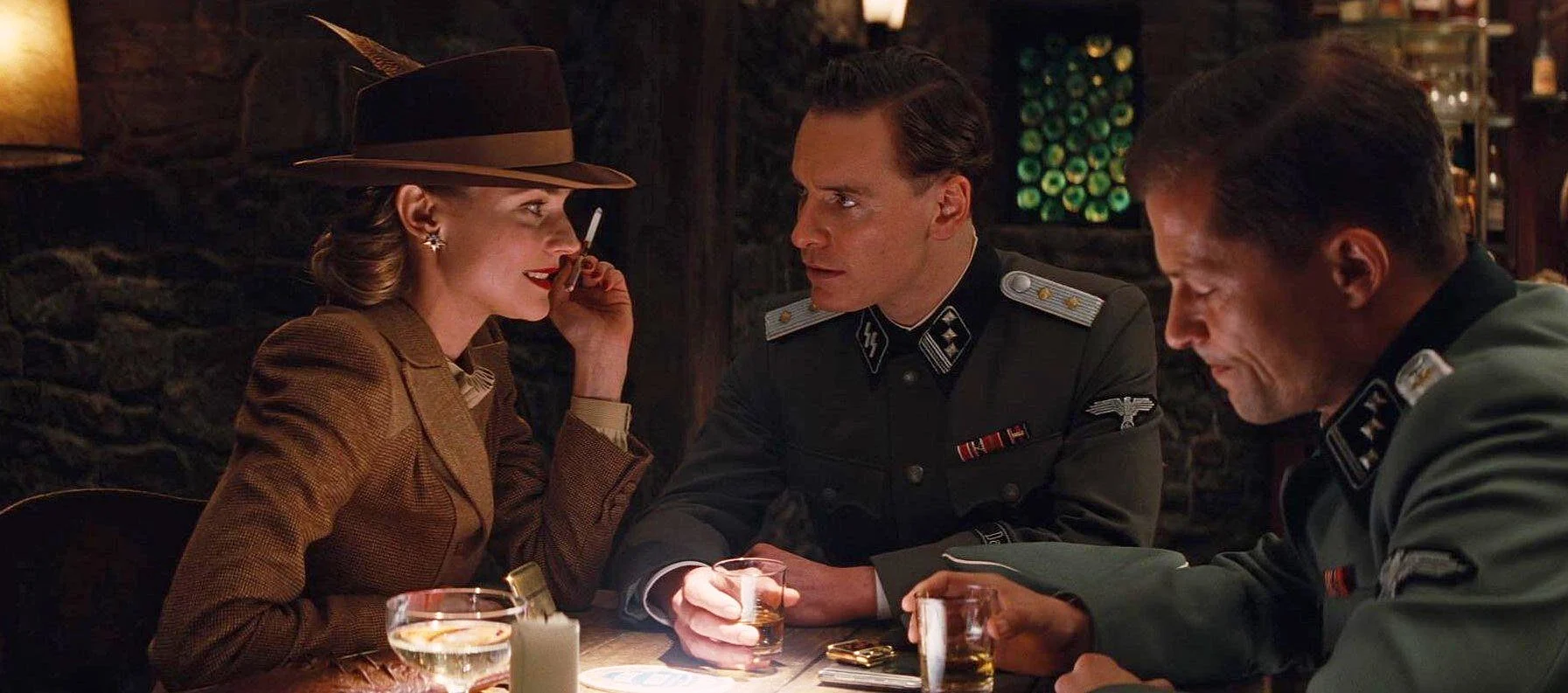
In this technical directorial analysis, we dissect how the production team utilized micro-spatial constraints, geometric blocking patterns, and linguistic anomalies to construct a pressure-cooker sequence that remains a monument in structural tension building.
1. Spatial Containment and Geometric Character Blocking
The primary directorial choice that dictates the sequence’s tension is the absolute isolation of the setting. By placing the characters in a cramped, windowless subterranean tavern, Tarantino severely restricts the physical parameters of the cinematic space. This spatial containment removes any possibility of casual movement or easy escape, forcing the camera—and the audience—to focus entirely on the micro-behaviors of the entities inhabiting the frame.
Within this closed perimeter, the character blocking is arranged in a rigid, confrontational geometric matrix. The British undercover operative, Lieutenant Archie Hicox, and the German actress Bridget von Hammersmark are seated at a central wooden table, physically surrounded by German soldiers celebrating a recent birth. This spatial arrangement creates an immediate, invisible layer of geometric friction. Every camera angle frames the protagonists not as active infiltrators, but as trapped entities whose survival depends on maintaining an absolute illusion of cultural conformity.
The Intrusive Proximity of Major Hellstrom
The structural equilibrium of the scene is violently disrupted by the physical relocation of Gestapo Major Dieter Hellstrom. Initially positioned in a shadowed, distant corner of the tavern, Hellstrom’s decision to move to the central table alters the entire spatial dynamic. Tarantino captures this intrusion through a series of tightening medium-close shots that emphasize the oppressive proximity of the antagonist.
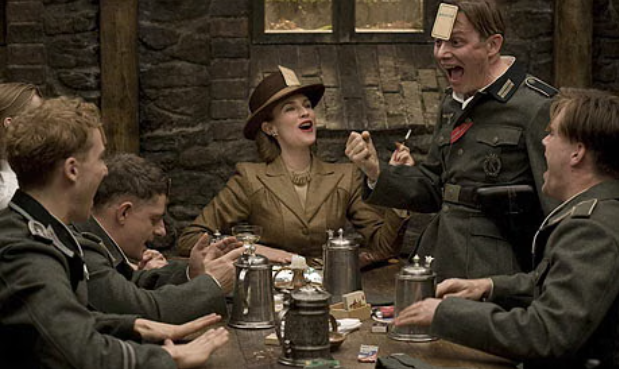
Hellstrom does not merely join the conversation; his physical placement cuts off the characters’ direct line of sight to the exit, effectively sealing the geometric trap. The camera tracking shots slow down, mimicking the cold, calculating gaze of the Gestapo officer as he deconstructs the minor social anomalies occurring at the table.
2. The Semiotics of Suspense and the Three-Finger Catastrophe
Tarantino’s narrative brilliance relies on turning mundane objects and cultural nuances into lethal plot devices. During the central parlor game, where characters guess the identity written on a card taped to their foreheads, the directing team uses the innocent context of drinking to execute an analytical interrogation. The suspense is sustained because the audience possesses dramatic irony: we are fully aware of the operatives’ true identities, making every laugh, toast, and look feel like a potential trigger for violence.
The Cultural Finger-Counting Anomaly
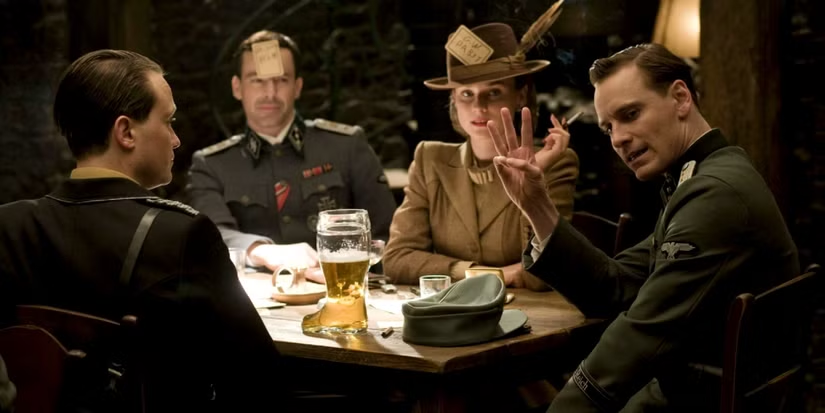
The sequence’s ultimate breaking point occurs not through a dramatic confession, but through a minute cultural error in non-verbal communication. When ordering a final round of scotch, Lieutenant Hicox signals the number three by raising his index, middle, and ring fingers. The camera instantly locks into an aggressive, tight insert shot of Hicox’s hand, isolating this specific anatomical gesture within the center of the screen.
To an English-speaking audience, the gesture is entirely normal, but within the European continent—specifically Germany—the number three is universally signaled starting with the thumb. This micro-spatial mistake is the exact moment the narrative illusion shatters. Tarantino pauses the audio tracking slightly, allowing the weight of Hicox’s mechanical error to resonate before Hellstrom’s expression shifts from Jovial amusement to lethal confirmation.
The Mathematical Execution of the Climax
Following the linguistic and semiotic exposure, the blocking transitions from stationary psychological standoff to immediate, explosive physical destruction. The camera setups, which had spent fifteen minutes executing long, slow circular pans around the table, suddenly fracture into hyper-kinetic, low-angle cuts that mirror the chaos of the gunfire.
The proximity of the characters ensures that the shootout is not an action sequence of tactical evasion, but a brutal, mathematical clearance of the physical space. By keeping the camera locked at table-height throughout the violent climax, Tarantino forces the viewer to remain trapped in the center of the crossfire, securing the tavern sequence’s legacy as one of the most structurally perfect exercises in sustained cinematic anxiety ever filmed.
The final outcome is a masterpiece of modern narrative direction where suspense is engineered not through external threats, but through the claustrophobic arrangement of physical space, the geometric locking of character placements, and a fatal breakdown in cultural semiotics.
Explore more technical breakdowns in our Direction & Narrative section.