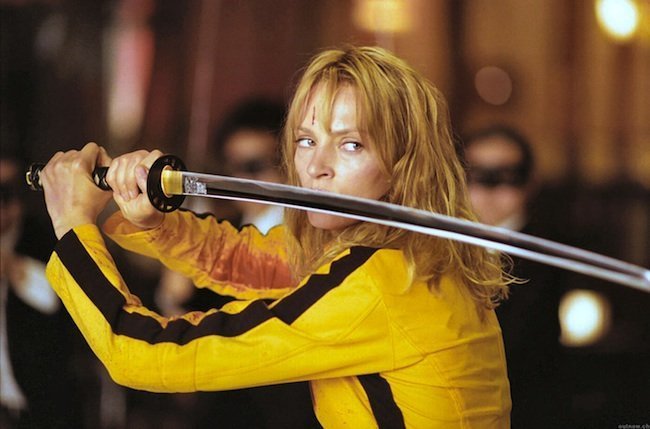
The visual landscape of Quentin Tarantino’s Kill Bill: Vol. 1 (2003) stands out as a highly complex exercise in historical stylistic pastiche, unified through a rigorous, contemporary cinematographic framework. Rather than deploying a generic Hollywood high-key saturation layout, cinematographer Robert Richardson engineered a hyper-segmented visual grammar designed to mimic, deconstruct, and elevate the distinct printing and lighting traits of global genre cinema. Shot on 35 mm film with Panavision anamorphic lenses, the production serves as a clinical masterclass in color space manipulation, extreme high-contrast lighting transitions, and deliberate optical defects that give each narrative segment a heavy, historical presence on screen.
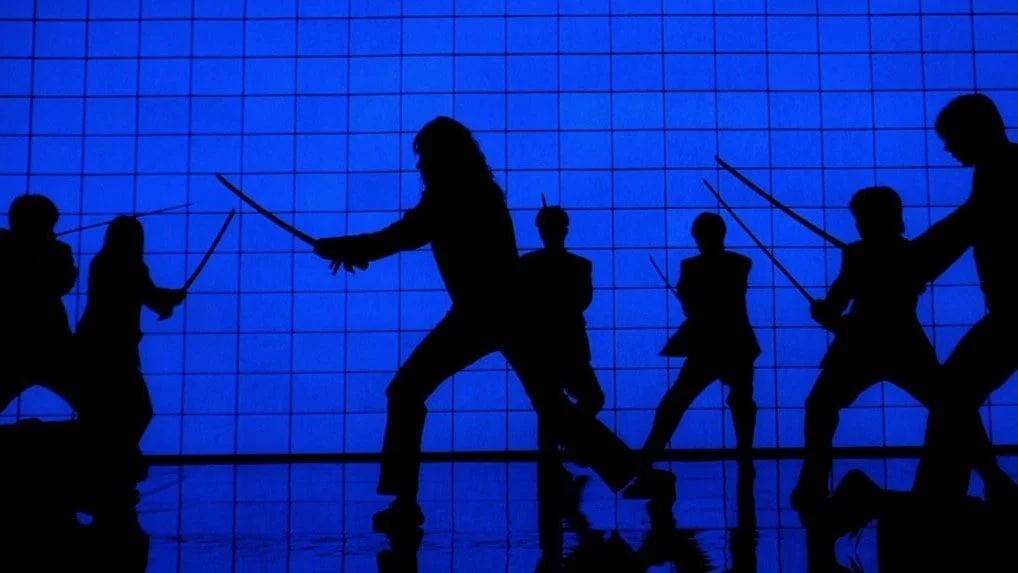
Anamorphic Distortion Metrics and the Architecture of Tokyo Neons
The spatial characteristics of the Tokyo sequences—culminating inside the legendary House of Blue Leaves—relied on the deployment of vintage Panavision Primo and C-Series anamorphic lenses. These specific optics introduce non-linear horizontal compression factors that inherently modify the behavior of out-of-focus background elements. Instead of rendering specular highlights as uniform circular patterns, the anamorphic elements compressed background light sources into distinct, elongated vertical ellipses, generating an expansive sense of depth that isolates the primary subject within dense urban environments.
To illuminate these sequences, Richardson implemented a complex multi-source primary lighting array dominated by high-saturation cyans, industrial ambers, and deep emerald greens. The technical crew bypassed standard soft diffusion filters, opting instead for high-output, raw incandescent fixtures placed at precise low angles to generate long, high-contrast shadow vectors. When characters or reflective metallic blades cut across these concentrated light fields, the lens configurations produced heavy horizontal streaks and primary halation loops. This precise mechanical behavior anchors the film’s modern digital intermediate processing within a classic, tactile, and older photographic framework, proving that contemporary action cinema gains immense physical authority when frames prioritize high-contrast depth over flat digital uniformity.
The Chromatic Isolation of the House of Blue Leaves
The framing throughout the final action sequence centers on strict geometric compositions balanced against stark, mathematical vanishing points. Richardson divides the spatial layout of the set using architectural wooden lines and sliding screens to control the spectator’s eye movement across the widescreen canvas.
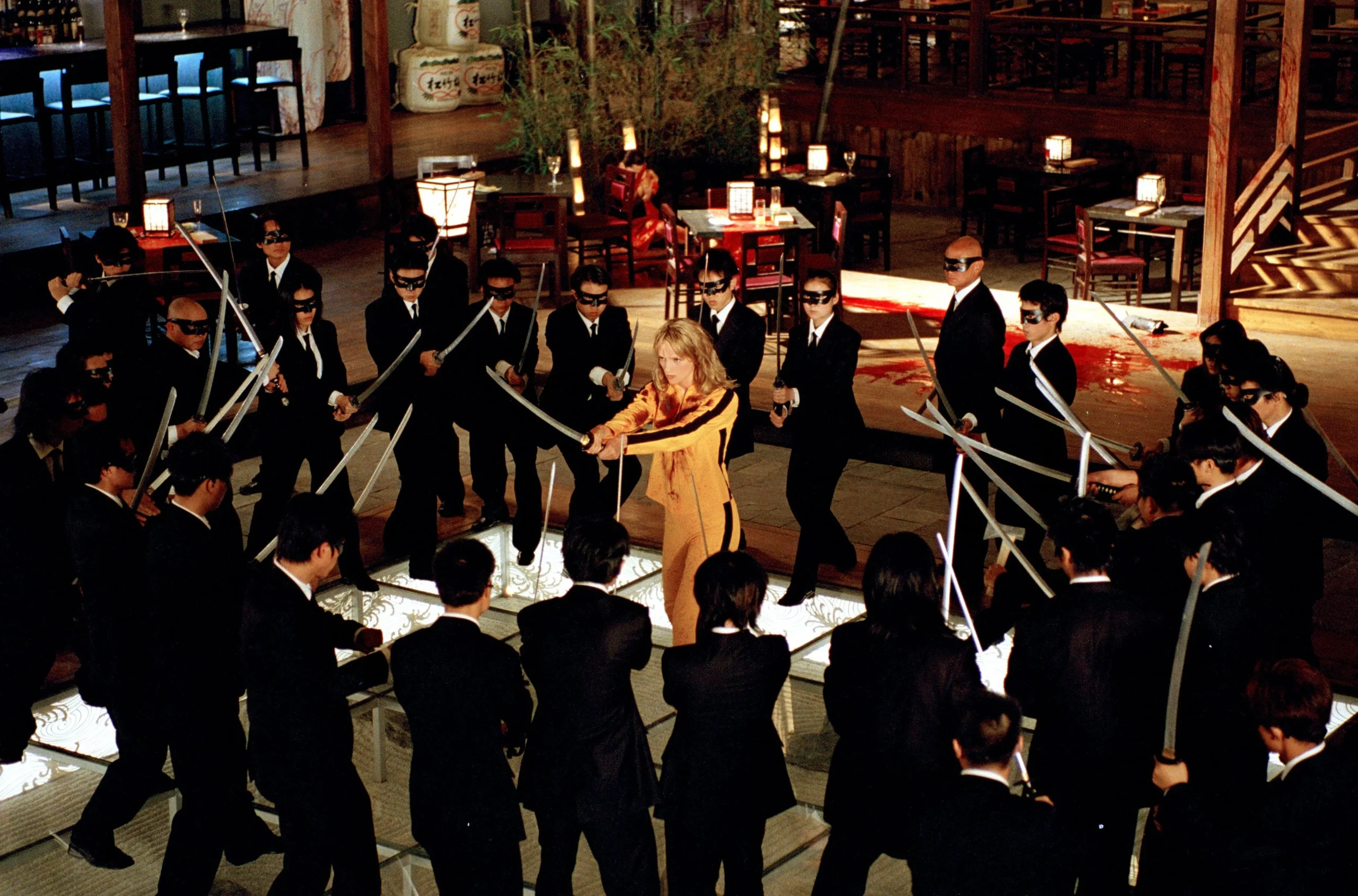
The camera execution remains highly calculated, balancing smooth, complex crane movements with rapid tracking shots. By maintaining strict control over lens acceleration and tracking orientation, the cinematography emphasizes the spatial mechanics of the fight choreography. The space itself feels highly deliberate and restrictive, turning a wide open hall into an oppressive, deadly maze where every diagonal composition points toward the central thematic threat.
Monochromatic Transitions and the Deconstruction of High-Contrast Film Stock
The artistic peak of the film’s visual processing occurs during the sudden, dramatic shift into a high-contrast monochromatic color space mid-way through the massive sword battle. Originally implemented as a technical fallback strategy to bypass international MPAA censorship regulations regarding high-volume biological fluid representation, this sequence was transformed by Richardson into a brilliant showcase of classical film stock deconstruction.
The Lighting Chemistry of Absolute Black and White
To successfully execute this transition within a high-contrast black-and-white framework without losing facial texture or geometric depth, the lighting team completely overhauled their illumination setups on location. They stripped away all soft fill lights, relying exclusively on single-source key lights positioned at aggressive 45-degree angles from the lens axis. This technique cuts the facial geometry of the performers in half, creating deep, absolute shadows across the eye sockets and nasal ridges while leaving the opposite side brilliantly exposed.
This heavy contrast transforms the sequence from a simple action showcase into a stark graphic tragedy. The camera tracks close-ups with extremely tight framing, capturing the fine micro-textures of blood splatters and steel reflections under shifting hard light fields. This rigorous adherence to high-contrast monochrome mechanics directly contrasts with the fluid, computerized camera pipelines required to render virtual environments, a structural evolution we deconstructed within our Avatar (2009) virtual cinematography breakdown, demonstrating that visual weight requires absolute devotion to either physical light limits or rigorous data telemetry tracking.
The Atmospheric Calm of the Zen Garden
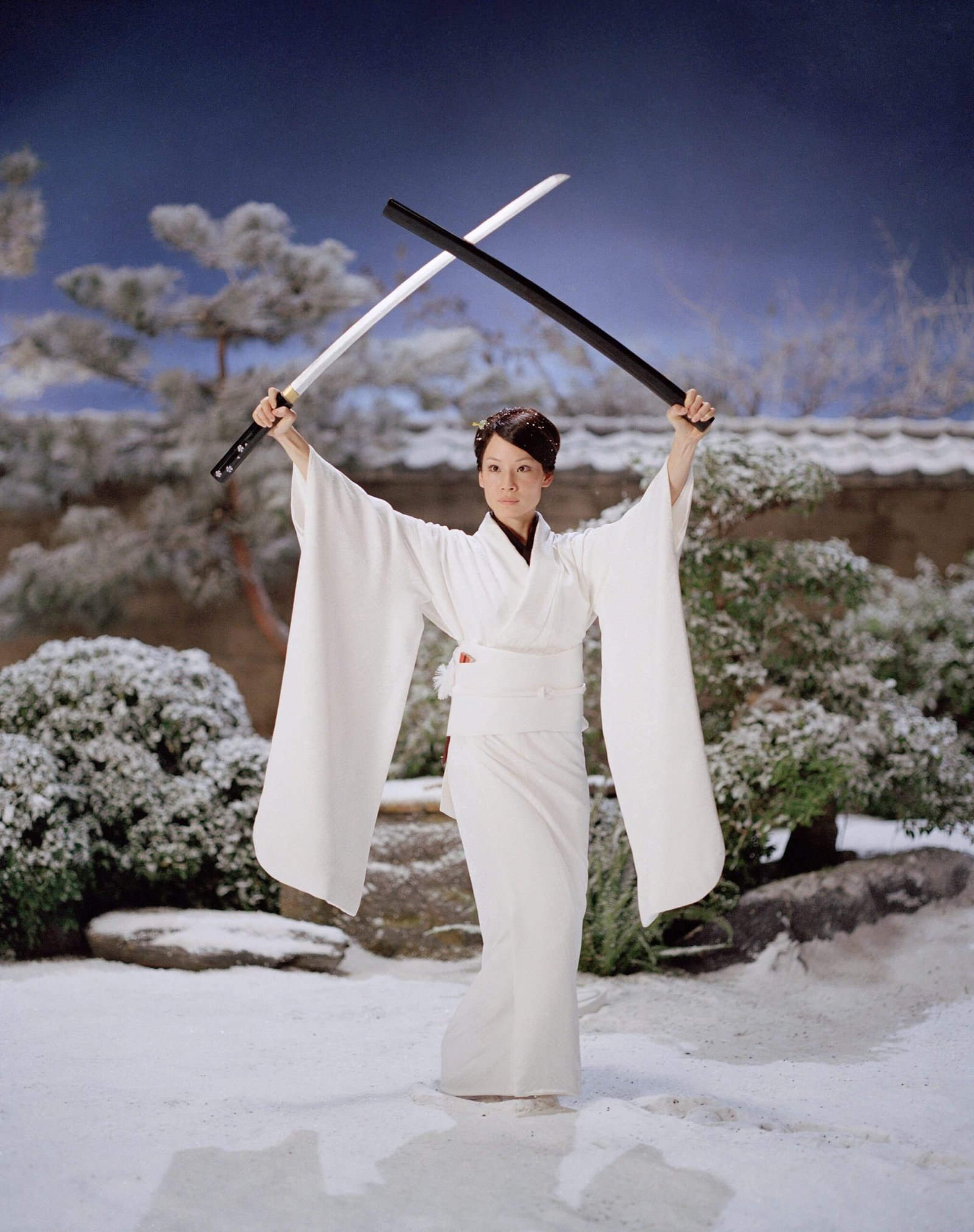
As the conflict transitions into the private garden of O-Ren Ishii, the cinematography undergoes a radical, calculating pivot in color temperature and contrast management. The harsh, high-contrast neons and heavy black shadows dissolve, replaced by a pristine, diffuse, and monochromatic color space dominated by absolute whites and cold, slate-grey tones. To simulate natural, unyielding winter light, Richardson deployed massive overhead diffusion silks that completely flattened the direct sun rays, casting soft, shadowless light fields across the snow-covered architecture.
The primary color spectrum is completely suppressed throughout this sequence, reserving high-saturation red values exclusively for the final, clean incision that ends the conflict. When that catastrophic event occurs, the bright crimson fluid erupts against the blank white canvas of the snow field, creating an optically undeniable visual punctuation point. This clean, clinical approach to managing atmospheric tones ensures that the visual narrative finishes with a cold, elegant, and timeless cinematic reality. The extensive execution of vintage anamorphic optical rigs, classical high-contrast monochrome lighting architectures, and a calculating system of primary color space segmentation successfully elevated an action revenge script into a heavy, beautifully complex exploration of visual history.
Explore more technical breakdowns in our Cinematography section.
1 thought on “High-Contrast Lighting Transitions: Optical Rigs in Kill Bill Vol 1 (2003)”
Comments are closed.