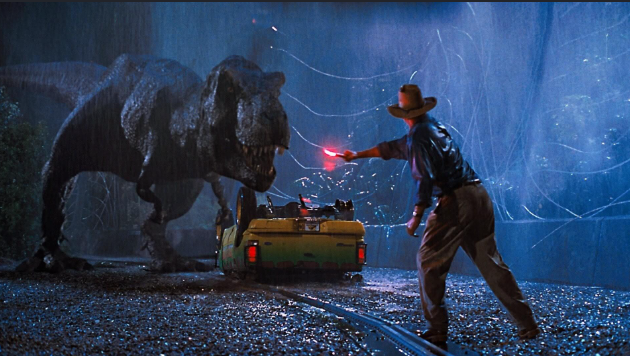
Steven Spielberg’s 1993 sci-fi masterpiece, Jurassic Park, fundamentally altered the technological trajectory of global cinema. While modern audiences often remember the film for its suspenseful pacing and iconic John Williams score, its true legacy lies in its pioneering visual grammar. Working alongside the legendary practical effects master Stan Winston and Dennis Muren’s digital team at Industrial Light & Magic (ILM), Spielberg constructed a groundbreaking cinematic ecosystem. Through a calculated synthesis of full-scale animatronics, photorealistic Computer-Generated Imagery (CGI), and innovative digital compositing, the visual effects of Jurassic Park bridged the gap between physical reality and digital illusion, setting a gold standard that contemporary Hollywood still struggles to match.
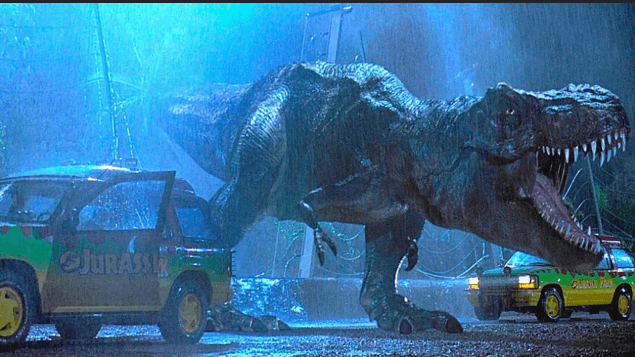
In this comprehensive analysis, we examine how Spielberg and his visual effects teams utilized specific computational breakthroughs and physical engineering to transform speculative creature design into an enduring cinematic milestone.
1. The Symbiosis of Animatronics and Digital Rendering
One of the most critical, yet frequently misunderstood, technical triumphs of Jurassic Park lies in its strict rule of visual symbiosis. In the early 1990s, computer graphics were flat, smooth, and lacked the organic imperfections of reality. Spielberg and visual effects supervisor Dennis Muren recognized that CGI could not carry the entire weight of the narrative. Instead, they established a strict protocol: physical animatronics would handle close-up character interactions, while digital models would execute wide shots requiring complex locomotion.
This technical boundary forced ILM to pioneer new computational algorithms. To match Stan Winston’s massive, hydraulically-powered T-Rex puppet, digital artists had to manually program skin physics, muscle jiggle, and subsurface scattering of light. Because the climactic T-Rex paddock sequence took place during a heavy downpour, computer scientists had to simulate water droplets interacting with digital dinosaur skin—a mathematical feat that pushed early 90s rendering hardware to its absolute processing limits. The resulting imagery possessed a tactile, weighty texture that prevented the creatures from looking like weightless digital overlays.
The Metaphor of Textural Continuity
By constantly cutting between the real, physical animatronic puppet and the digital model within the same scene, Spielberg tricked the human brain into a state of cognitive acceptance. Because the viewer’s eyes verified the authenticity of the dinosaur’s skin, teeth, and dilating pupils in the close-ups, the brain automatically applied that same verified authenticity to the digital version running across the wide frame. This brilliant editing and visual effects strategy eliminated the “uncanny valley” effect, making the prehistoric creatures feel menacingly physical rather than artificially rendered.
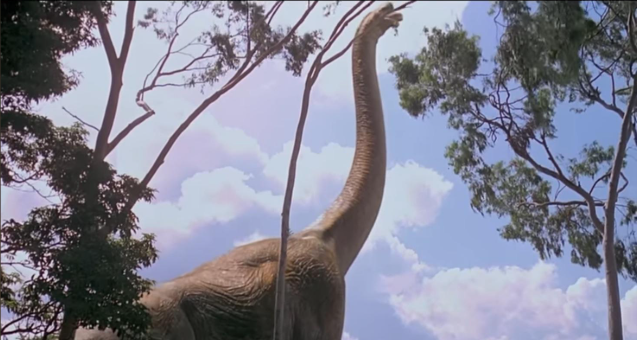
This strict adherence to physical constraints ensured that the digital environment never detached from reality. Rather than overusing the newly discovered digital tools, the visual effects serve as a structural extension of the physical set, treating extraordinary biological illusions with a grounded, documentarian camera discipline.
Computational Lighting as a Narrative Anchor
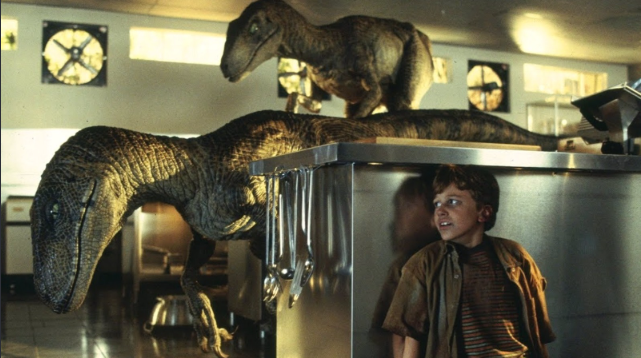
The technical integration of CGI models required ILM to manually replicate the exact lighting setups designed by director of photography Dean Cundey. Unlike modern automated lighting engines, every single highlight, shadow, and neon reflection on the digital Velociraptors in the kitchen sequence had to be mapped frame by frame. Digital compositors matched the soft, fluorescent overhead lighting of the theme park’s kitchen to the digital skin shaders.
This rigorous technique added crucial layers of spatial depth to the anamorphic frame. When a raptor stalks the children behind a stainless-steel table, its digital silhouette casts an accurate shadow onto the real-world environment, anchoring its physical presence within the kitchen. Computational lighting alignment prevented the digital assets from floating in a visual vacuum, constantly tying their structural volume to the physical geometry of the set.
2. Unconventional Motion Controls and the Geometry of the Dinosaur Input Device
Beyond digital rendering breakthroughs, Jurassic Park relied heavily on engineering innovations to translate the traditional craft of stop-motion animation into the digital realm. The project faced a severe bottleneck: traditional computer animators did not understand animal locomotion, and legendary stop-motion animators (like Phil Tippett) did not know how to use computers. To bridge this technological divide, engineers invented the Dinosaur Input Device (DID).
The Authority of the Hybrid Armature
The DID was a highly sophisticated, electronic stop-motion armature wired directly to computers running early softimage 3D software. Phil Tippett and his team could manipulate the physical metal joints of the dinosaur model by hand, and the computer would record those coordinates in real time, converting them into digital keyframes.
This engineering breakthrough accomplished two monumental tasks. Technically, it preserved the weight, pacing, and masterfully articulated motion that stop-motion animators spent decades perfecting, eliminating the robotic stiffness typical of early computer animation. Narratively, it allowed the camera tracking parameters to stay mathematically locked to the real-world physical dimensions of the set. The digital creature ceased to be an independent graphic; it became a structurally tracked element that respected the physical boundaries, speed limitations, and gravity of the live-action environment.
Symmetrical Compositing and Spatial Threat
ILM’s digital compositing frequently relied on strict mathematical rules of spatial continuity. During the famous vehicle attack scene, the digital T-Rex is framed using wide, low-angle lens tracking that matches the perspective of the trapped characters inside the Ford Explorer. The visual boundaries of the glass sunroof and metallic door frames create a structural grid that traps the digital dinosaur within the characters’ direct line of sight.
This meticulous coordination balanced the chaotic horror of the sequence. No matter how fluid or fast the digital renders moved, their interaction with the real-world elements (shattering glass, bending metal, mud splashing) remained structurally accurate and perfectly balanced. This harmony between physical destruction and computational rendering is the foundation of Spielberg’s timeless visual language.
The result is a motion picture where the visual effects do not merely showcase computer technology; they construct an authentic biological reality. Through its pioneering software engineering, boundary-pushing animatronics, and rigorous spatial tracking, the visual effects of Jurassic Park remain an absolute masterclass in cinematic illusion, proving that when technology is bound by physical rules, it becomes completely immortal.
Explore more deep dives in our Effects & VFX section.