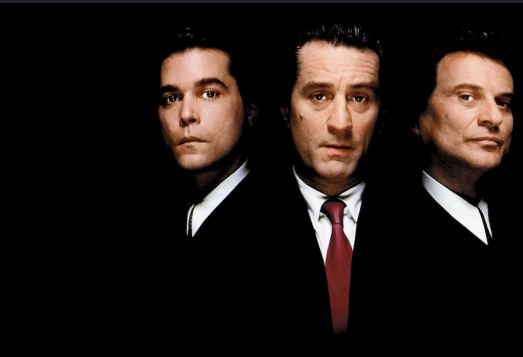
Martin Scorsese’s 1990 crime epic, Goodfellas, fundamentally dismantled the traditional, romanticized tropes of the American gangster film. While contemporary critics frequently praise the picture for its razor-sharp dialogue and pop-infused soundtrack, its true cinematic brilliance lies in its radical narrative architecture. Working alongside editor Thelma Schoonmaker and cinematographer Michael Ballhaus, Scorsese engineered a hyper-kinetic visual style that mirrors the manic, drug-fueled escalation of its subjects. Through a calculated implementation of subjective camera movement, structural voice-over authority, and aggressive editing tempos, the direction of Goodfellas transforms an expansive decades-long biography into a breathless, cohesive masterclass in visual storytelling.
In this comprehensive analysis, we examine how Scorsese utilized specific directorial choices and structural editing parameters to elevate a chaotic criminal chronicle into an immortal benchmark of narrative pacing.
1. Voice-Over Authority and the Mechanics of Subjective Immersion
The structural spine of Goodfellas relies heavily on its dual voice-over narration, primarily driven by the protagonist, Henry Hill. In conventional screenwriting, extensive voice-over is often criticized as a lazy tool for exposition. However, Scorsese subverts this constraint by utilizing the voice-over not merely to convey plot points, but to control the psychological proximity between the audience and the underworld.
This directorial choice forces the camera to act as a direct extension of Henry’s internal state. When Henry narrates his childhood fascination with the mob, Scorsese aligns the lens at a lower perspective, capturing the neighborhood gangsters as towering, mythical entities. The voice-over acts as an authoritative acoustic guide that normalizes extreme criminality. Because Henry’s tone is casual, charismatic, and pragmatic, the viewer is systematically manipulated into adopting his distorted moral compass. The narration serves as a psychological filter, stripping away objective judgment and replacing it with visceral, subjective participation.
The Metaphor of the Freeze-Frame
To freeze the narrative timeline at moments of high emotional volatility—such as Henry witnesssing a bombing or being beaten by his father—Scorsese introduces abrupt freeze-frames. This technique functions as a structural punctuation mark within the cinematic grammar. By freezing the frame while the voice-over continues, the direction visualizes the act of memory itself. Henry is looking back, isolating specific trauma and snapshots of power. This visual friction between static imagery and kinetic audio strips the glamour from the lifestyle, trapping the character within the amber of his own calculated choices.
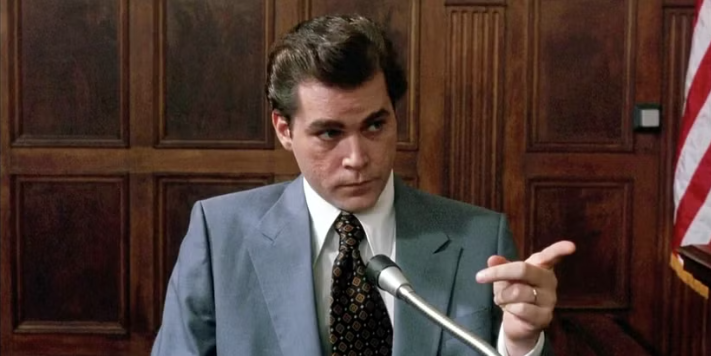
This structural manipulation culminates in the final courtroom sequence, where Henry steps out of the witness box and addresses the camera directly. By breaking the fourth wall, Scorsese shatters the cinematic illusion entirely. The subjective voice-over has materialized into a physical confrontation, forcing the audience to acknowledge their complicity as consumers of his violent confession.
Spatial Blocking and the Geometry of the Copacabana Steadicam
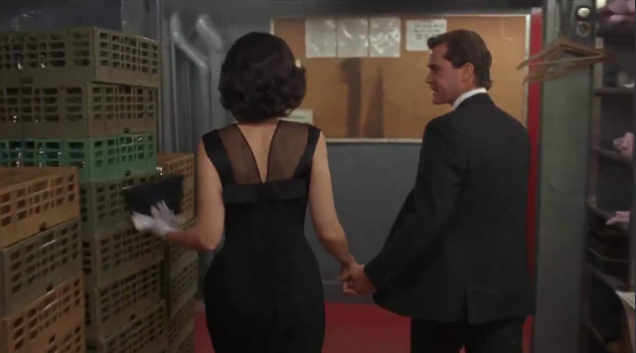
The pinnacle of Scorsese’s spatial direction is the legendary three-minute Steadicam shot tracking Henry and Karen through the underbelly of the Copacabana nightclub. Rather than deploying standard master shots and coverage cuts, Scorsese blocks the entire sequence in a single, uninterrupted fluid motion. This technical choice serves an acute narrative purpose: it physicalizes the seductive, frictionless nature of criminal power.
The continuous movement maps out a labyrinthine layout—moving through back alleys, service kitchens, and narrow corridors—before bursting into the glamour of the main showroom. By keeping the camera locked closely behind the couple, the audience experiences the spatial orientation in real time. The environment bends to Henry’s will; doors open, tables are carried forward, and authority figures bow. The geometry of the shot establishes a visual momentum that illustrates why Karen is seduced by this world: it is a space free of friction, barriers, or delays.
2. Kinetic Editing Tempos and the Geometry of Paranoia
While the first half of the film utilizes elegant, sweeping tracking shots to mirror the smooth ascension of the characters, the final act completely accelerates the editing syntax to document their absolute moral and psychological decay. The famous “May 11, 1980” sequence is a masterclass in kinetic directorial tempo.
The Authority of the Jump Cut
To convey Henry’s cocaine-induced paranoia and the claustrophobic pressure of a federal investigation, Scorsese and editor Thelma Schoonmaker abandoned smooth continuity editing in favor of jarring, aggressive jump cuts and rapid panning shots.
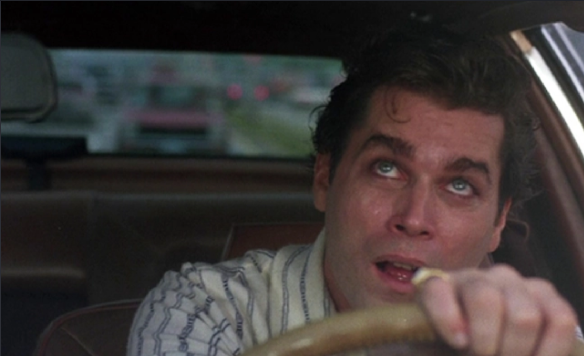
This editing disruption accomplished two tasks simultaneously. Technically, it shatters the viewer’s spatial and temporal orientation, shifting angles and focal lengths erratically within a split second to mimic the frantic pacing of Henry’s mind. Narratively, it traps the viewer inside a cycle of impending doom. The camera cuts violently from a helicopter overhead, to the stove, to a drug transaction, and back to the steering wheel. The rhythmic symmetry of the film’s earlier acts is completely obliterated. The frame ceases to be an elegant showcase of power; it becomes a fractured cage driven by panic.
The result is a motion picture where the direction does not merely document the chronological rise and fall of a mafia associate; it weaponizes the cinematic language to replicate the psychological allure and eventual horror of that life. Through its innovative voice-over structures, boundary-pushing Steadicam blocking, and volatile kinetic editing, the narrative pacing of Goodfellas remains an absolute masterclass in direction, proving that the rhythm of a film can shape the audience’s psychological immersion as powerfully as the script itself.
Explore more deep dives in our Direction & Narrative section.