Quentin Tarantino’s 1994 masterpiece, Pulp Fiction, fundamentally redefined the aesthetic and narrative boundaries of independent American cinema. While much of the film’s critical legacy centers on its non-linear screenplay and pop-culture-infused dialogue, its visual grammar is equally revolutionary. Working alongside director of photography Andrzej Sekula, Tarantino crafted a distinct, hyper-stylized world that paid homage to classic crime cinema while establishing a modern visual identity. Through deliberate choices in low-speed film stock, unconventional framing, and calculated character blocking, the cinematography of Pulp Fiction transforms the gritty underbelly of Los Angeles into a vibrant, neo-noir comic book landscape.
In this comprehensive analysis, we examine how Tarantino and Sekula utilized specific technical choices and visual storytelling to elevate a gritty crime anthology into a timeless cinematic masterpiece.
1. Film Stock Selection and the Saturation of Pop Culture
One of the most critical, yet frequently overlooked, cinematographic triumphs of Pulp Fiction lies in Sekula’s choice of film stock. During the early 1990s, the cinematic trend favored high-speed, grainier film stocks that allowed for naturalistic, low-light shooting. Tarantino and Sekula deliberately subverted this trend by shooting almost the entire film on Kodak 50 ASA, the slowest and lowest-grain film stock available at the time.
This technical choice required the production crew to flood every set with an immense amount of artificial studio lighting, even during daytime interior scenes. The slower film stock resulted in an image of extraordinary sharpness, deep contrast, and rich, highly saturated colors. This high-key saturation removed the film from the dark, muddy realism typical of contemporary crime dramas, instead giving it a glossy, pristine texture that perfectly mirrored the aesthetic of the pulpy magazines from which the movie draws its name.
The Metaphor of High-Gloss Noir
By bringing intense brightness to scenes of violence and criminal transactions—such as Brett’s apartment or the diner—the cinematography strips away the traditional shadows of classic Film Noir. The viewer cannot find refuge in dark corners; the criminality is exposed under a clinical, high-contrast glow. This visual irony enhances the dark humor of the script, treating extraordinary acts of violence with a bright, casual indifference.
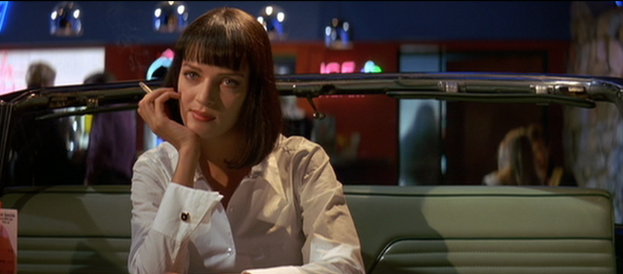
This aesthetic choice ensures that the urban environment feels larger than life. Rather than documenting the reality of Los Angeles, the cinematography constructs a mythical, neon-soaked underworld where every color pop feels intentional and stylized.
Depth of Field as a Narrative Constraint
The intense lighting setups required by the 50 ASA film stock allowed Sekula to shoot with a deep depth of field. In traditional dialogue scenes, directors often use a shallow focus to blur the background and isolate characters. Pulp Fiction frequently keeps both the foreground and background in sharp focus, forcing the audience to process the environment alongside the actors.
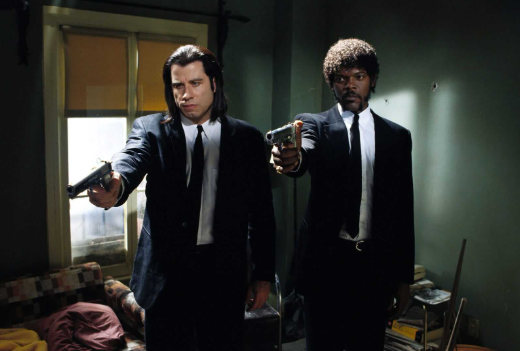
This technique adds layers of visual information to every frame. When Vincent Vega and Jules Winnfield walk down a hallway discussing foot massages, the background architecture remains crisp, grounding their absurd conversation within a stark, physical reality. The depth of field prevents the characters from existing in a vacuum, constantly tying their identities to the mundane spaces they inhabit.
2. Unconventional Framing and the Geometry of the Trunk Shot
Beyond the texture of the film stock, Pulp Fiction relies heavily on specific camera placements and character blocking to manipulate the audience’s perspective. Tarantino and Sekula avoided standard coverage, opting instead for wider focal lengths and iconic, low-angle perspectives that have since become definitive staples of modern visual vocabulary.
The Authority of the Low Angle
The film’s utilization of the low-angle perspective is masterfully executed during moments of shifting power dynamics. The most famous example is the signature “Trunk Shot,” where the camera is placed inside the dark trunk of a car, looking up at Jules and Vincent as they retrieve their weapons.
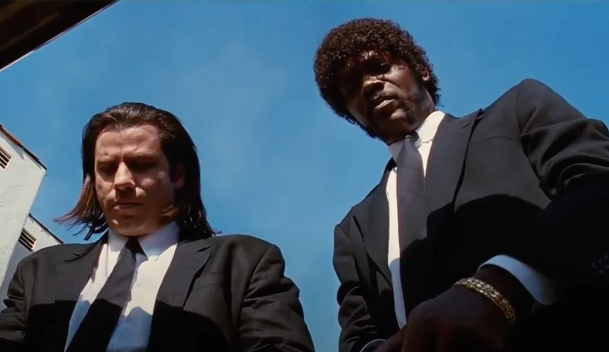
This camera placement accomplishes two tasks simultaneously. Technically, it uses the physical frame of the trunk lid to create a geometric “box” around the characters, focus-pulling the viewer’s eye directly to their expressions. Narratively, it places the audience in a submissive, subterranean position, establishing Jules and Vincent as dominating figures of authority within the cinematic frame. The car trunk ceases to be an ordinary prop; it becomes a structural frame within a frame that traps the audience inside the criminals’ routine.
Symmetrical Blocking and Group Dynamics
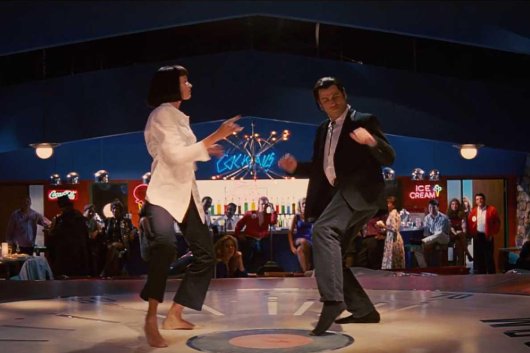
Sekula’s composition frequently relies on formal, almost theatrical symmetry. Characters are often blocked in parallel lines or perfect geometric arrangements across the wide anamorphic frame. During the iconic dance sequence at Jack Rabbit Slim’s, the camera locks into a steady, tracking wide shot that preserves the spatial symmetry of Mia and Vincent’s choreography against the nostalgic backdrop of the restaurant.
This meticulous blocking balances the chaotic energy of the script. No matter how unpredictable or violent the characters’ actions become, the visual framing remains strict, calculated, and perfectly balanced. This contrast between narrative chaos and visual order is a core component of Tarantino’s cinematic language.
The result is a motion picture where the camera does not merely observe the criminal underworld; it shapes it. Through its slow film stock, razor-sharp focus, and bold structural framing, the cinematography of Pulp Fiction remains an absolute masterclass in visual style, proving that the way a story is captured can become as iconic as the story itself.
Explore more deep dives in our Cinematography section.