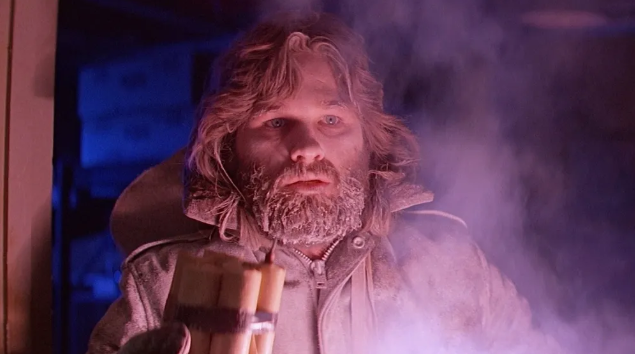
When John Carpenter released The Thing in 1982, cinema was on the precipice of a digital revolution. Yet, the film stands today as the absolute zenith of practical visual effects, a testament to what can be achieved through physical chemistry, mechanical engineering, and raw artistic vision. While modern horror frequently leans on computer-generated imagery (CGI) that often lacks physical weight, Carpenter, alongside special effects wizard Rob Bottin, created a grotesque, shifting antagonist that remains terrifyingly real because it physically existed in front of the camera lens.
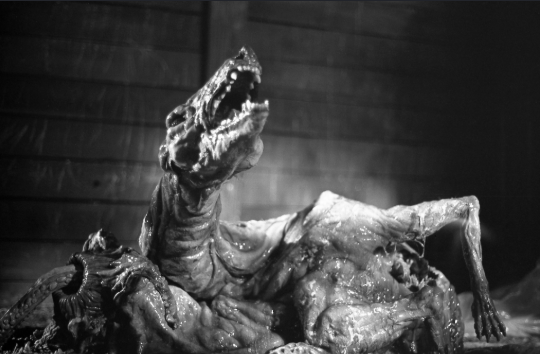
In this technical breakdown, we analyze how Bottin’s practical effects studio pushed the boundaries of illusion, structural design, and biological abstraction to redefine cinematic body horror.
1. The Materials of Mutation: Organic Chemistry on Screen
To design an alien creature capable of mimicking any living organism, Rob Bottin had to abandon traditional monster costumes. The creature in The Thing does not possess a fixed shape; it is an ongoing biological crisis. Achieving this fluidity required an unprecedented mixture of synthetic materials and kitchen chemistry.
The production consumed thousands of pounds of foam latex, urethane plastics, and silicone compounds. Foam latex allowed the animatronic pieces to move with flesh-like flexibility, while silicone provided a translucent quality that mimicked organic tissues under light. To create the constant sheen of moisture that makes the monster look genuinely alive, the crew coated the models in industrial lubricants, food-grade jellies, and massive quantities of methylcellulose—the slimy substance typically used to thicken milkshakes.
The Visceral Reality of Weight
The crucial difference between these 1982 physical fabrications and modern digital rendering is how they interact with the environment. When a practical creature asset moves across the floor, it physically collides with the set pieces, displaces air, and catches the actual studio lighting setups designed by director of photography Dean Cundey.
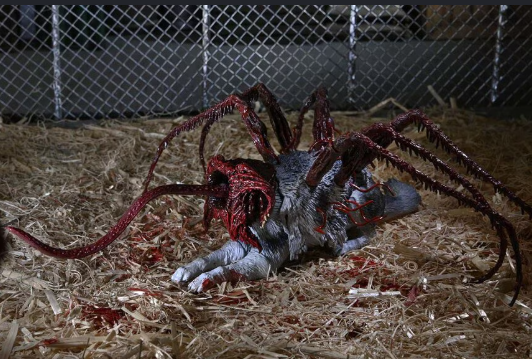
During the infamous defibrillator sequence where Vance Norris’s chest tears open into a massive, tooth-lined mouth, the production utilized a hyper-realistic fiberglass torso cast from actor Charles Hallahan. The teeth were made of carved acrylic, and the flesh pulled away using hidden hydraulic wires below the operating table. The resulting violence has an undeniable tactile impact because the actor’s hands are genuinely interacting with a physical mass, generating an authentic performance tension that green screens cannot reproduce.
2. Animatronics and Mechanical Puppetry: Engineering Terror
Behind every layer of melting latex lay highly complex mechanical skeletons. Bottin’s team engineered intricate cable-controlled animatronics that required dozens of hidden operators working beneath the floors of the sets to orchestrate a single creature movement.
These armatures were welded from steel and aluminum, using aircraft control cables to manipulate facial expressions, expanding rib cages, and flailing tentacles. The mechanical complexity meant that a single sequence required precise choreography between the camera crew, the actors, and the effects technicians operating the puppet rigs.
The Spider-Head Sequence
Perhaps the most surreal image in the entire film is Vance Norris’s detached head growing spider-like legs and walking across the floor. This iconic sequence required multiple distinct practical models to pull off the illusion sequentially.
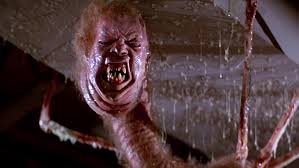
The initial stretch of the neck was achieved using a highly elastic plastic compound called tent-mender, which was heated from inside the prop head so it would stretch and melt dynamically on camera. The walking head itself was a radio-controlled device guided along a track beneath the floor boards. By breaking down the transformation into distinct, mechanical steps, Carpenter and Bottin created an impossible image that feels completely grounded in physical reality.
3. The Blair-Monster: The Ultimate Challenge of Scale
For the film’s massive climax, the production designed the “Blair-Monster,” a gigantic amalgamation of various creatures the alien had consumed throughout its journey. This massive prop was so large and heavy that it could not be operated via simple hand cables; it required a full hydraulic control matrix.
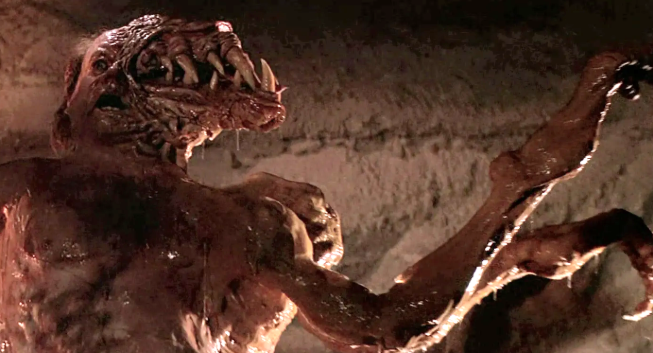
The creature incorporated a full-sized mechanical dog chassis, a flaying web of urethane tentacles, and a distorted replica of actor A. Wilford Brimley’s face. To move a structure of that scale, the crew built an industrial steel crane mechanism under the floorboards. When the monster bursts through the wood planks, it is tearing through actual material using real mechanical force. The destruction is not an optical layer added in post-production; it is a live-action event occurring in real-time space.
The Timelessness of the Physical Asset
The ultimate triumph of John Carpenter’s approach to visual effects is its exceptional longevity. Digital effects from the late 1990s and early 2000s look severely dated today because computing power and lighting algorithms evolve rapidly. Physical objects, however, never age in terms of their spatial reality.
Because the latex, the slime, the steel armatures, and the simulated blood occupied physical space and reflected genuine light rays into Dean Cundey’s camera lenses, the monster in The Thing possesses an immutable, tactile presence. It remains a masterclass of visual effects design, proving that the most terrifying monsters are the ones that actually stand in the room with the characters.