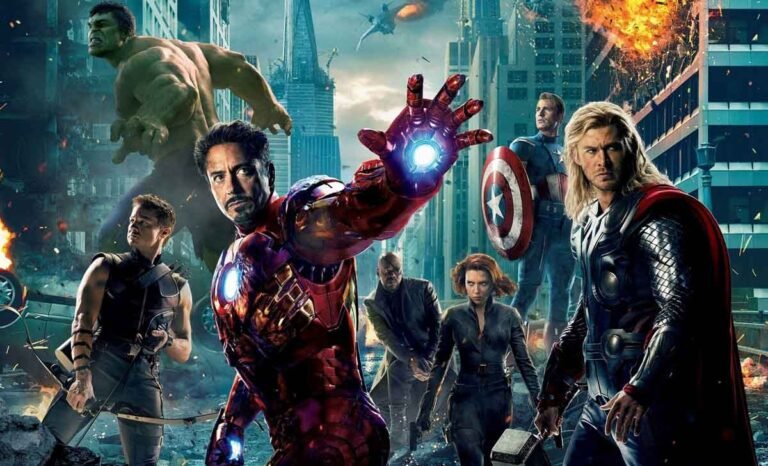
Sustaining narrative equilibrium within a multi-protagonist blockbuster represents one of the most volatile challenges in contemporary commercial filmmaking. Prior to the release of Joss Whedon’s The Avengers (2012), Hollywood conventional wisdom dictated that a massive multi-franchise crossover movie would inevitably collapse under the sheer weight of its split character dynamics, resulting in a fractured, poorly paced narrative. The production team subverted these structural constraints by deploying rigorous spatial cross-cutting techniques, dialectical character pairings, and a centralized thematic anchor. Instead of treating the film as a traditional linear action block, the direction approached the narrative as a complex symphonic arrangement, where individual character motifs are systematically introduced, conflicted, and eventually synthesized within a unified spatial canvas.
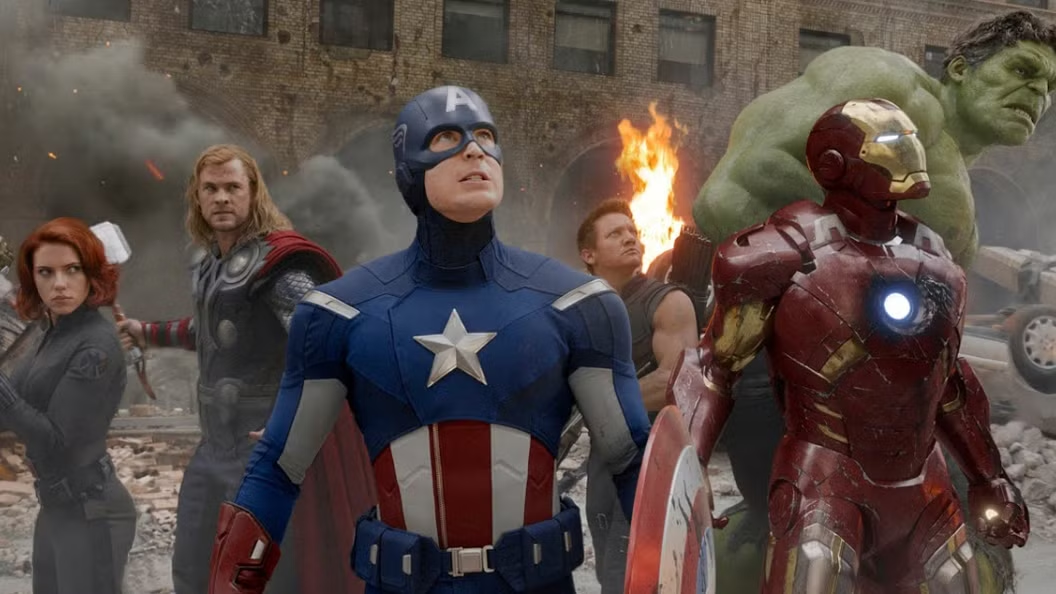
In this technical directorial analysis, we deconstruct the narrative mechanics required to sustain ensemble pacing, examine the structural execution of spatial cross-cutting during the Battle of New York, and analyze how the camera blocking establishes spatial authority.
1. The Mechanics of Multi-Protagonist Ensemble Pacing
The primary directorial challenge of The Avengers is the distribution of narrative real estate. To prevent any single entity from monopolizing the emotional core of the film, Whedon instituted a balanced structural framework based on dialectical character pairings. By grouping the protagonists into conflicting ideological duos—Tony Stark’s technocratic individualism against Steve Rogers’ bureaucratic collectivism, or Thor’s mythological royalty against Bruce Banner’s volatile biological trauma—the direction creates immediate, self-sustaining narrative friction.
This dialogue-driven tension ensures that the first two acts progress rapidly despite the absolute containment of the setting within the subterranean and airborne parameters of the S.H.I.E.L.D. Helicarrier. The camera framing reinforces this psychological containment; the direction relies heavily on tight medium-shots within narrow metallic corridors, trapping the heroes in close proximity. This visual restriction heightens the underlying thematic conflict, making their eventual physical and ideological fracturing feel mathematically inevitable.
The Thematic Anchor of the Helicarrier Breach
The narrative transitions from psychological friction to kinetic momentum during the mid-movie Helicarrier breach. Directorial control during this sequence shifts toward multi-level parallel editing. The audience is forced to track four independent structural crises simultaneously: Banner’s uncontrollable biological mutation, Iron Man fixing the physical turbine engine, Captain America fighting hostile infiltrators on the exterior catwalks, and Black Widow outsmarting Loki’s psychological trap.
To prevent this cross-cutting from fracturing the viewer’s geographical orientation, the editing team uses a continuous sonic thread—the escalating hum of the failing engine and centralized radio communications—to anchor the different spatial levels within a singular, urgent window of cinematic time.
2. Spatial Cross-Cutting and the 360-Degree Synthesis
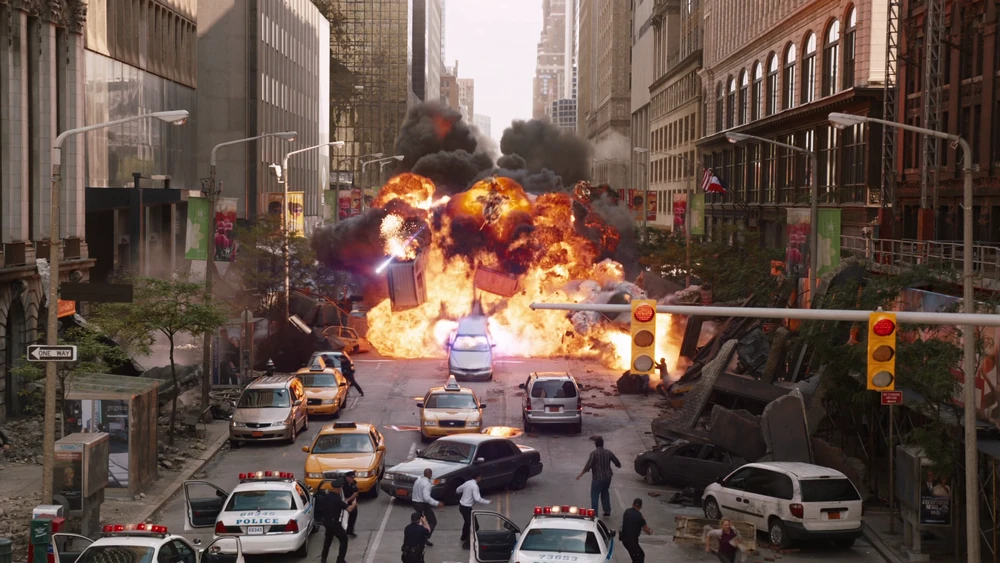
The structural zenith of the narrative direction occurs during the third-act Battle of New York. The sequence stands as a monument in spatial cross-cutting, transforming a massive metropolitan landscape into a highly legible, interconnected tactical chessboard. Rather than utilizing generic, chaotic action montages, the camera blocking tracks the physical topography of Manhattan with calculated geographic precision.
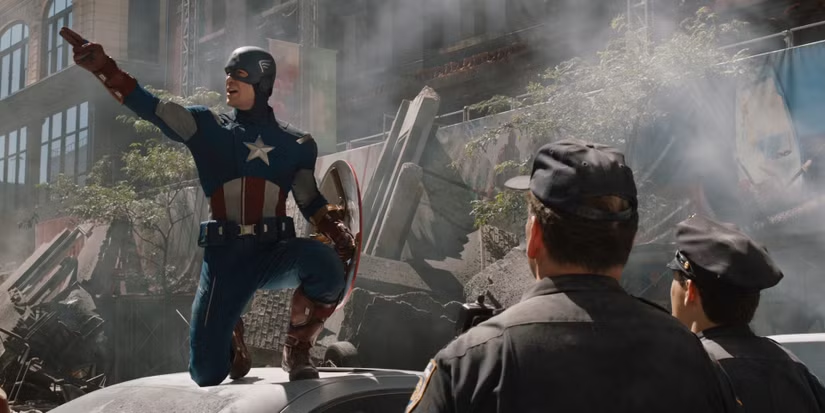
Clear operational zones are established within the urban center: Captain America commands the ground-level perimeter, Black Widow handles low-altitude aerial hijacking, Hawkeye occupies the elevated vertical surveillance towers, and Iron Man manages the atmospheric airspace. The editing weaves between these distinct altitudes seamlessly, using match-cuts on motion and directional camera pans to maintain a continuous, fluid sense of shared physical space.
The Architectural Unification of the One-Shot
This spatial legibility culminates in the iconic, continuous 360-degree panning tracking shot that circles the six protagonists as they assemble on the streets of New York. This shot is not mere visual spectacle; it is the definitive structural synthesis of the entire movie’s narrative architecture. For nearly dos acts, the characters were separated by close-up framing and isolated compositions. By pulling the lens back into a sweeping, uninterrupted circle, the direction visually erases their individual boundaries, cementing their transformation from a loose collection of volatile anomalies into a single, unified corporate entity.
Kinetic Continuity and Asset Hand-Offs
Following this assembly, the film executes a breathtaking, multi-tiered virtual “one-shot” that moves continuously from the street level up to the skyscrapers. The virtual camera tracks Iron Man flying down a canyon of buildings, hands off the narrative momentum to Captain America and Black Widow fighting on a bridge, pans down to follow a crashing alien vehicle, and locks onto Hulk smashing through a skyscraper structure.
This kinetic continuity requires masterfully planned editorial hand-offs, where the exit of one character asset from the frame perfectly triggers the entrance of the next. By maintaining an unbroken fluid tracking motion, the direction mimics the mechanics of a live-action documentary crew tracking a real military conflict, sealing The Avengers’ position as a permanent masterpiece of structural narrative clarity.
The final outcome is a triumph of modern commercial direction where colossal action is engineered not through superficial visual chaos, but through the claustrophobic containment of characters, rigorous parallel editing setups, and a flawless execution of multi-tiered spatial cross-cutting.
Explore more technical breakdowns in our Direction & Narrative section.