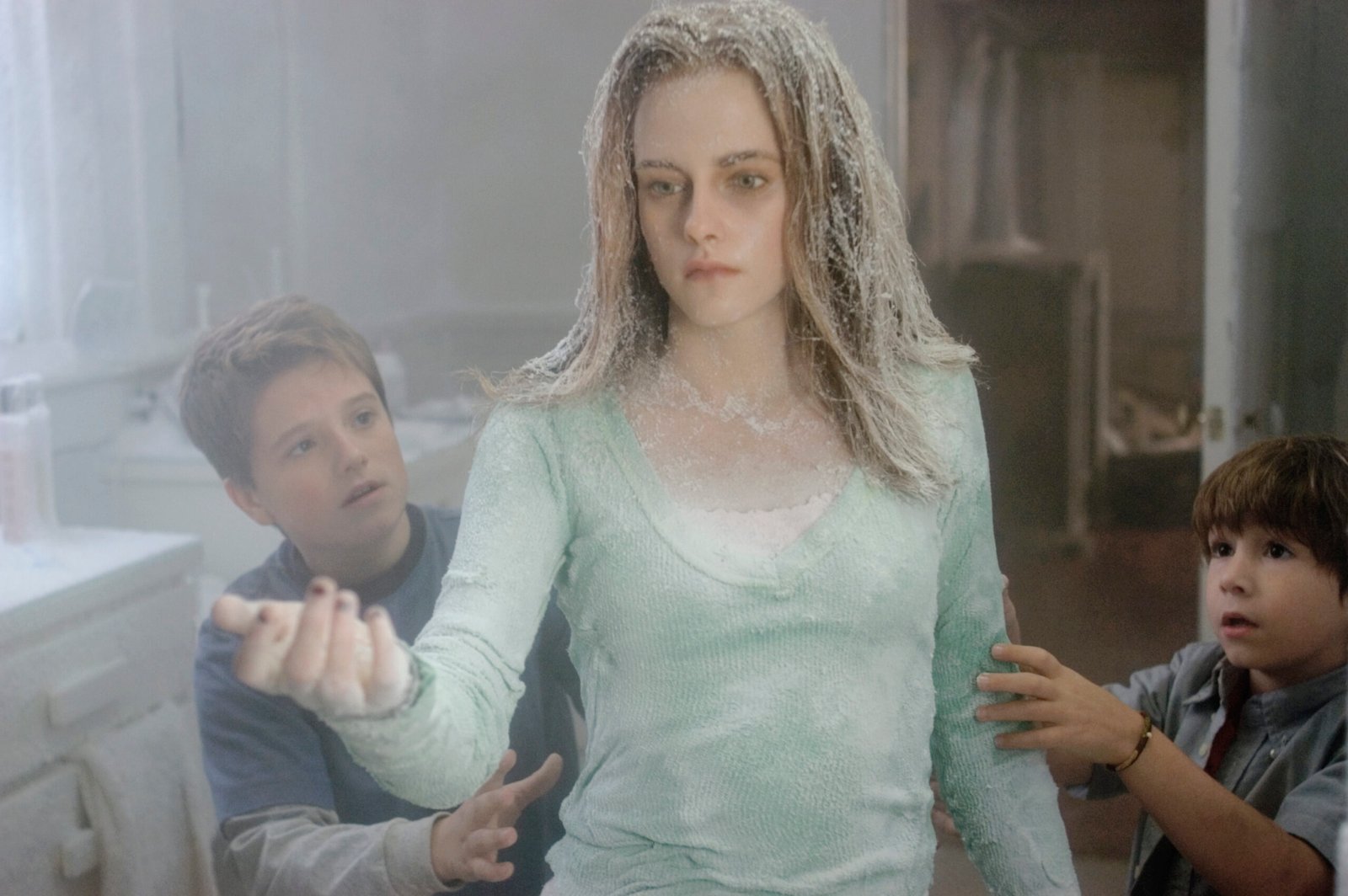
In the historical evolutionary trajectory of contemporary American science fiction cinema, Jon Favreau’s Zathura: A Space Adventure (2005) stands as an aggressive, unyielding monument to classical practical special effects orchestration. Executed during a transitional industry epoch heavily dominated by expanding digital software convenience, the production intentionally bypassed high-frequency CGI rendering pipelines. Instead, the physical architecture of the film’s visual framework was engineered through sophisticated scale-miniature cinematography, autonomous full-scale robotics, and detailed prosthetics. This rigorous mechanical methodology structures an acute sense of weight, high-contrast surface illumination, and spatial permanence that modern digital rendering matrices frequently fail to duplicate.
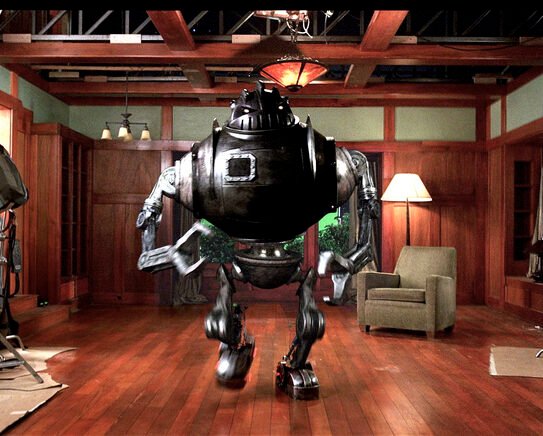
The Stan Winston Cybernetic Matrix: Autonomous Animatronics and Kinetic Weight
The defining structural pinnacle of the production’s mechanical framework relies on the deployment of the autonomous rogue robot, engineered by the legendary Stan Winston Studio. Rather than formatting the entity via post-production pixel interpolation, the studio constructed a physical, eight-foot-tall hybrid specimen utilizing aerospace-grade aluminum frameworks, high-torque servomechanisms, and detailed urethane skin molds. This operational layout allowed the machine to execute intricate, multi-axial kinetic movements directly on the practical set, maintaining an authentic physical footprint that forced the child performers to respond to true physical mass.
To operate this mechanical giant without visible tethering arrays, the engineering team divided the robot’s core functions into a sophisticated dual-control layout. The internal telemetry loop utilized real-time radio frequency (RF) tracking networks paired with direct cable actuators managed by a team of concealed puppeteers. This allowed for immediate conversational latency adjustment between the mechanical articulation of the steel limbs and the human performers. Because the robot occupied the exact coordinate space as the practical household set, the high-contrast directional lighting arrays from the studio grid reflected authentically across its polished metal plates and weathered rivets. This eliminated the typical edge-blending anomalies and matte-line desaturation common in early-2000s green-screen compositions, locking the entity into a seamless spatial bond with the environment.
The Anatomy of the Zorgon Prosthetic Overlays
The tactical deconstruction of the antagonistic alien force—the Zorgons—followed the same strict physical discipline. Bypassing digital crowd-replication software, the creature design utilized structural prosthetic suits worn by professional physical performers.

The suits featured underlying fiberglass undershells that distributed the shifting kinetic weight of the mechanical tails and articulated jaw matrices. The outermost dermal layers were cast in custom-formulated silicone matrices that simulated realistic light sub-surface scattering. This structural execution allowed the creature geometry to deform naturally during physical locomotion, ensuring that skin folds, muscle contractions, and deep shadows tracking along the reptilian scales occurred in real-time correlation with the physical shifts of the set.
Scale-Miniature Volumetrics and the Physics of Widescreen Destructive Sequences
The visual execution of the space sequences and house-destruction arcs breaks away entirely from the sterile perfection of traditional digital simulation models. To physicalize the cosmic vacuum and external hull integrity fractures, the effects direction relied on large-scale model architectures suspended within absolute black velvet backdrops.
The Mechanical Fragmentation of the Domestic Architecture
To successfully execute the explosive atmospheric decompression sequences when meteor showers puncture the domestic framework, the production built an expansive, 1:5 scale duplicate of the entire craftsman house structure. This miniature array was engineered using real lath-and-plaster components, structural timber segments, and micro-engineered explosive charges.
When the combustion sequence was initiated, the camera captured the mechanical fragmentation of the materials at high speed—ranging from 120 to 250 frames per second. This temporal dilation allows the spectator to trace the organic vector maps of splintering wood, fracturing plaster, and genuine low-velocity dust dispersion fields. The resulting footage introduces an immutable physical chaotic feedback loop that digital particle engines cannot synthesize, maintaining a strict adherence to genuine mass and spatial displacement laws. The physical elements tumble through the wide anamorphic fields with authentic gravity metrics, cementing the scene as a raw masterclass in structural destruction.

The Optical Integrity of the Cosmic Backdrop
The starfields, nebulae, and planet surfaces throughout the spatial transit sequences were constructed utilizing layered optical transparency plates and deep fiber-optic light boards. This technique avoided the color space compression errors inherent in digital blue-screen extraction systems.
By capturing the physical miniatures and the light-emitting backgrounds within a unified optical pass, the lens preserved absolute depth-of-field integrity across the entire horizontal widescreen grid. The fine edges of the house model—including drifting debris fields and micro-fractures—retained sharp focus profiles against the deep space vacuum. This calculating approach avoided the plastic-like sheen and flat composition matrices of contemporary digital workflows, proving that visual tension peaks when directors refuse to sacrifice physical weight or spatial permanence for electronic convenience.
Explore more technical breakdowns in our Effects & VFX section.