
The cinematic landscape of the late 2010s reached an unprecedented computational and engineering zenith with the release of Marvel Studios’ Avengers: Endgame in 2019. Serving as motion picture history’s most monumental narrative convergence, the production required an industrial-scale visual effects pipeline that completely dissolved the boundary between live-action capture and synthetic digital creation. Rather than relying solely on traditional green-screen staging and optical compositing, Marvel’s visual effects supervisors—orchestrated across global facilities including Industrial Light & Magic (ILM), Wētā FX, and Digital Domain—implemented an end-to-end digital asset framework driven by high-density photogrammetry, real-time facial retargeting, and machine-learning neural networks. This massive convergence of software engineering and cinematic storytelling established a new technological benchmark for digital human synthesis and complex multi-pass simulation pipelines in contemporary Hollywood blockbusters.
The Medusa Rig: Sub-Millimeter Facial Capture and Neural Retargeting
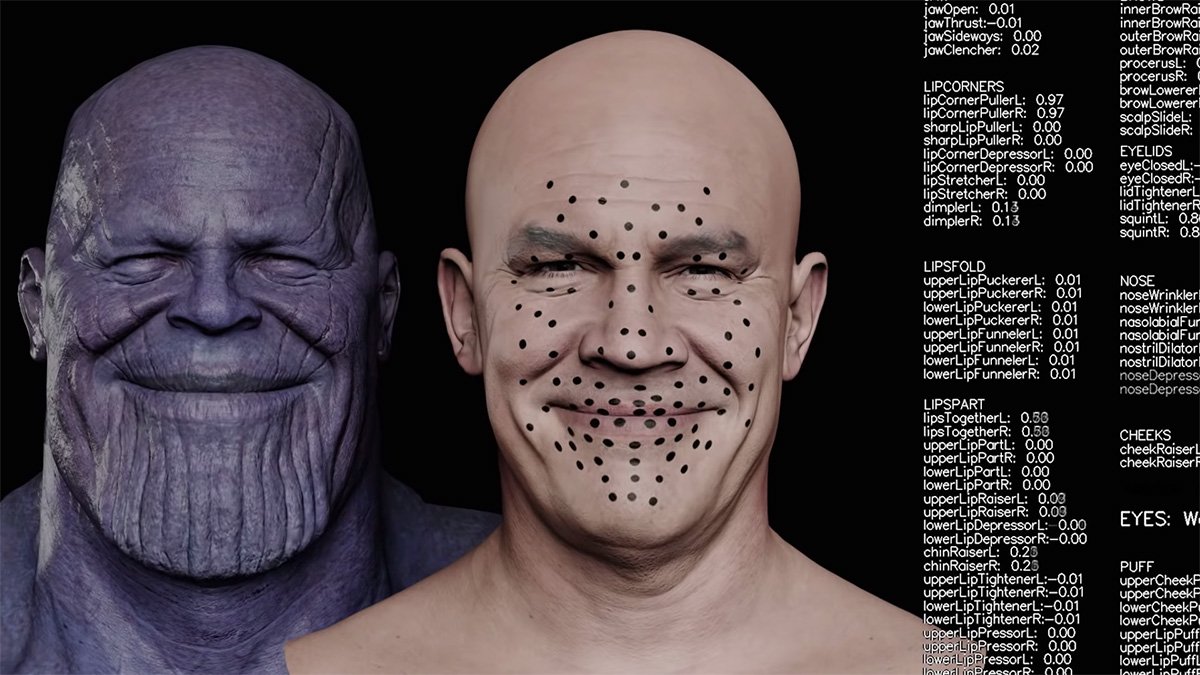
One of the most technically demanding hurdles in Avengers: Endgame was the photorealistic realization of digital principal characters, most notably Josh Brolin’s antagonist Thanos and the de-aged iterations of the core superhero roster. To capture performance nuances without the artificial jitter of early-generation motion tracking, ILM utilized their proprietary Medusa rig—a multi-camera photogrammetric capture system surrounding the actor’s face with dozens of synchronized high-resolution optical sensors.
Unlike legacy marker-based tracking that interpolated movement from discrete points, the Medusa system recorded raw surface geometry at sub-millimeter precision for every single frame of performance. This dense polygon cloud was then translated into a canonical rigged mesh using custom machine-learning neural networks. The algorithms analyzed muscle flexure, blood flow simulation maps, and skin sliding dynamics, transferring Josh Brolin’s micro-expressions onto Thanos’s massive alien topology with absolute anatomical fidelity. This algorithmic approach eliminated the uncanny valley effect, proving that synthetic facial animation could successfully convey subtle emotional gravitas and psychological wear without relying on physical prosthetic makeup.
Volumetric Stage Integration and Real-Time On-Set Pre-Visualization
The physical scale of the battle sequences necessitated a complete overhaul of traditional on-set lighting and camera operations. The climax featuring the decimated Avengers compound required actors to perform within massive volumetric capture stages surrounded by expansive LED volumes and high-speed tracking arrays. Rather than forcing actors to react to empty green spaces, technical directors deployed real-time viewport compositing tools powered by customized Unreal Engine pipelines running on high-end workstation clusters.
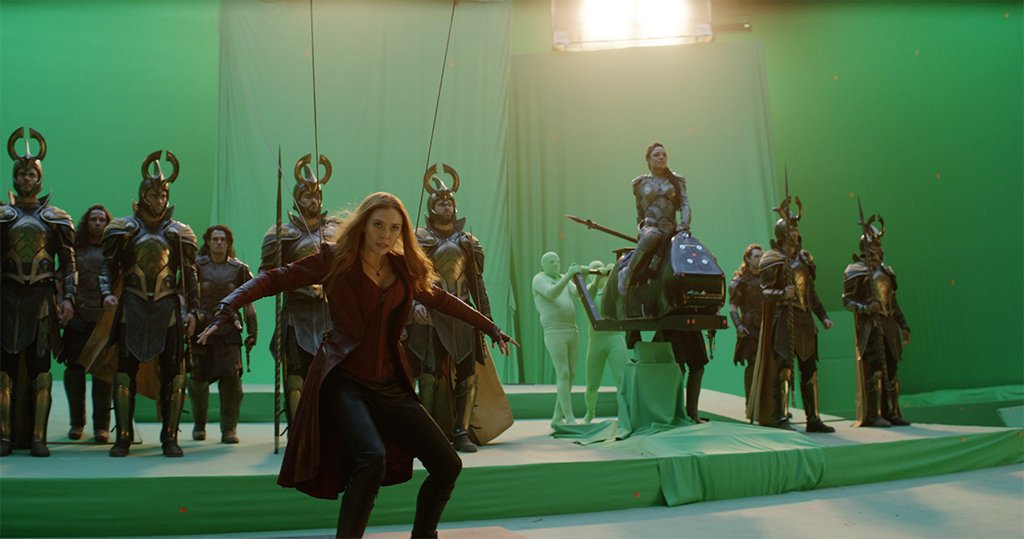
By synchronizing physical camera encoders with virtual coordinate spaces, cinematographers could preview rough CGI compositions and lighting passes live through the camera viewfinder during principal photography. This rigorous technical integration drastically reduced optical guesswork during downstream post-production compositing, ensuring that physical shadows cast by actors matched the multi-directional illumination vectors of the synthetic destruction environments. This meticulous attention to spatial coherence directly mirrors the lighting constraints we analyzed in our Toy Story 1995 effects breakdown, demonstrating that whether rendering a simple plastic toy or a photorealistic cosmic battlefield, digital visual authority relies entirely on strict mathematical alignment between virtual light sources and physical geometry.
Simulating Mass Destruction: Fluid Dynamics and Rigid Body Destruction
The cinematic scope of the final confrontation required the destruction of millions of square meters of digital architecture, presenting an immense computational load for distributed render farms. Every collapsing column, shattering piece of concrete, and billowing plume of atmospheric dust was governed by advanced physics simulation solvers operating within Houdini and proprietary enterprise software matrices.
Voxel-Based Fluid Solvers and Distributed Particle Collisions
To compute the dynamic behavior of smoke, fire, and pulverized stone, visual effects artists utilized high-resolution voxel-based fluid solvers. Unlike geometric animation, these fluid simulations calculated velocity, density, and temperature across three-dimensional grid volumes at the voxel level. When Thanos’s flagship bombarded the compound, the simulation engine executed millions of rigid body collision calculations simultaneously, tracking how fractured concrete debris interacted with volumetric smoke density and shockwave air displacement.
The sheer scale of these simulation passes required massive cluster distribution across thousands of remote server nodes. Data caching protocols had to compress terabytes of voxel velocity vectors into lightweight geometry caches without losing micro-turbulence detail. This complex engineering pipeline ensured that every falling slab of masonry carried convincing physical weight and momentum on screen, anchoring impossible comic book spectacles in undeniable physical realism.

Neural De-Aging and Temporal Stabilization Pipelines
Beyond massive environmental destruction, Avengers: Endgame pushed the boundaries of digital character longevity through advanced neural de-aging algorithms applied to characters across different timeline sequences. Utilizing convolutional neural networks trained on archival footage from earlier cinematic entries, digital artists analyzed bone structure changes, skin elasticity degradation, and subdermal fat distribution across decades.
The neural network automatically processed raw plate footage frame by frame, applying temporal stabilization filters to prevent high-frequency jitter in the skin texture maps. Artists then performed manual micro-compositing passes to ensure that specular highlights in the eyes and light scattering through epidermal layers remained physically accurate. This hybrid workflow of artificial intelligence assistance and human artistic oversight redefined the limits of chronological manipulation in modern cinema.
Explore more technical breakdowns in our Effects & VFX section.